Mottle Round 3 vs Round 4
The transition between Round 3 and Round 4 marks the boundary between introductory evasion and high-density stealth. Rather than reviewing individual rounds in isolation, comparing these two stages reveals how adding a third seeker fundamentally alters arena navigation.
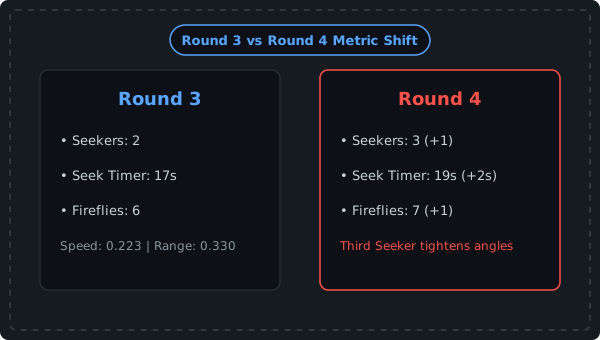
Direct Parameter Comparison
The table below highlights the exact mathematical step between Round 3 and Round 4:
| Parameter | Round 3 | Round 4 | Tactical Impact |
|---|---|---|---|
| Seeker Count | 2 Seekers | 3 Seekers | +50% more search units |
| Seek Timer | 17 seconds | 19 seconds | +2 seconds required survival |
| Fireflies | 6 fireflies | 7 fireflies | +10 potential points (+70 total) |
| Seeker Speed | 0.223 units/s | 0.234 units/s | Slightly faster patrols |
| Vision Range | 0.330 units | 0.340 units | Extended reach across tiles |
| Clear Bonus | +300 points | +400 points | Greater round reward |
The Disappearance of Safe Blind Spots
In Round 3, two seekers patrol the 25-tile arena. Because each seeker occupies only one patrol line at a time, opposite corners and unpatrolled perimeter edges frequently remain empty for several seconds. Players can comfortably wait out timers in unmonitored zones.
In Round 4, the formula 1 + floor(4 / 2) introduces the third seeker. With three independent AI entities patrolling simultaneously, true blind spots disappear entirely. At almost any given second, at least one seeker is either scanning or facing toward every quadrant of the board.
Corner camping, which works reliably in earlier rounds, becomes a liability in Round 4. When three seekers converge, vision cones interlock, leaving no open corridors to flee if your camouflage breaks.
Compressed Movement Windows
In Round 3, finding a safe 2-second movement window to pick up fireflies is straightforward. One seeker might be facing away while the other executes a 1.7-second stationary scan, giving you ample time to cross two tiles and settle into camouflage.
In Round 4, movement windows compress to narrow fractions of a second. As soon as Seeker A turns away, Seeker B may enter patrol across your intended path while Seeker C scans from the perimeter. Moving across colored tiles resets camouflage in 0.22 seconds and enforces a minimum visibility of 0.55.
Attempting prolonged traversal in Round 4 usually triggers immediate detection. Players who succeed in Round 4 take micro-steps: moving one tile, restoring full camouflage for 0.75 seconds, observing all three seekers, and then advancing again.
Strategic Focus: Fireflies vs Clear Bonus
While Round 4 spawns 7 fireflies worth a combined 70 points, the round clear bonus awards +400 points. Risking a life to grab a distant firefly in Round 4 represents poor risk management. Surviving the 19-second timer delivers over five times the value of all fireflies on the board combined.
Understand how late-game rounds scale once seekers stop adding by exploring Round 5 and Beyond. Learn the underlying detection numbers in How Camo Works, review the Scoring System, or check our verified Rules Index.